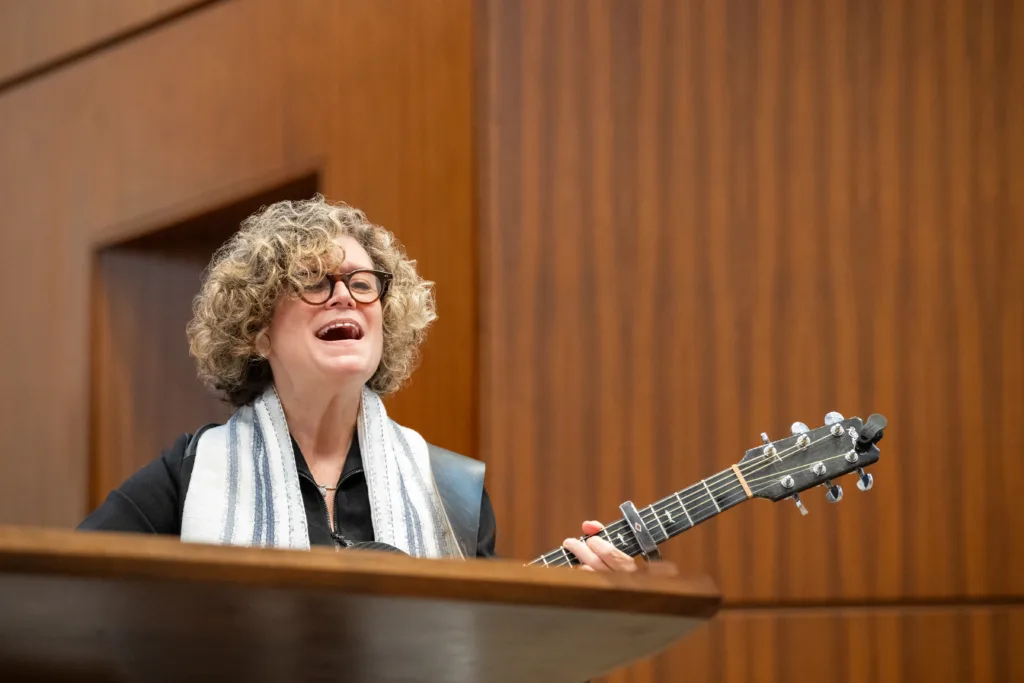
Beth Schafer
I have gotten so many comments about the song I do with a teen singer each year on Yom Kippur, I thought you would be interested in its story. The song, Ya’aleh Tachanuneinu, first came to me through Rabbi Brad. A classmate of his in San Diego included it in his congregation’s Yom Kippur worship with the rabbi’s daughter singing the solo part. Brad was moved enough to share it with me, and I concurred. We needed to do it at Sinai too. I received the arrangement from Brad’s colleague, wrote a violin part to make full use of our wonderful ensemble, and worked to identify the right voice to sing the solo. The first two years we offered it, Rachel Branum sang the solo. The next two years it was MJ Dorfman and this year it was Camryn Startt. Each student has brought a purity of voice to the hauntingly beautiful piece and has made the song a highlight of our Yom Kippur experience.
But, where does it come from? That has a much more interesting story. The original song is not Ya’aleh Tachanuneinu, and in fact, is not liturgical at all. It began as an Israeli pop song by the artist, Eviatar Banai. It’s title, Yeish Li Sikui, means, “I have a chance,” and was about overcoming addiction. The viral arrangement pairing the Yom Kippur piyut (liturgical poem) Ya’aleh Tachanuneinu with Eviatar Banai’s melody for Yesh Li Sikui was originally conceived by Anat Silverstone. Silverstone made the creative connection between the lyrics of the prayer and the melancholic, hopeful melody of the song. The arrangement was later recorded and popularized by the students and musical team at Ein Prat – The Israel Midrasha.
The liturgical poem Ya’aleh Tachanuneinu translates to “May Our Supplications Ascend.” It is a medieval anonymous prayer recited on the eve of Yom Kippur (although it is so beautiful we include in our morning worship as well). The poem follows a strict structural pattern built around a timeline of a single day (from evening, to morning, to the next evening), charting the spiritual journey of forgiveness. Here is the translation:
May our supplications ascend from the evening,
And may our cries arrive by morning,
And may our songs of praise be seen until evening.
May our voices ascend from the evening,
And may our righteousness arrive by morning,
And may our redemption be seen until evening.
May our refuge ascend from the evening,
And may it come for God’s sake by morning,
And may our atonement be seen until evening.
May our groans ascend from the evening,
And may they reach You by morning,
And may God look favorably upon us until evening.
The music of our Holy Days come from many places and many eras. What has become the “sound of Sinai” is a reflection of composers from 19th, 20th and 21st century – both American and Israeli. It is our sincere hope that the music resonates with you and elevates your worship experience. To all who have reached out with questions and comments, I appreciate you and am always happy to talk about the music that fills our sanctuary.
Shabbat shalom,
Beth