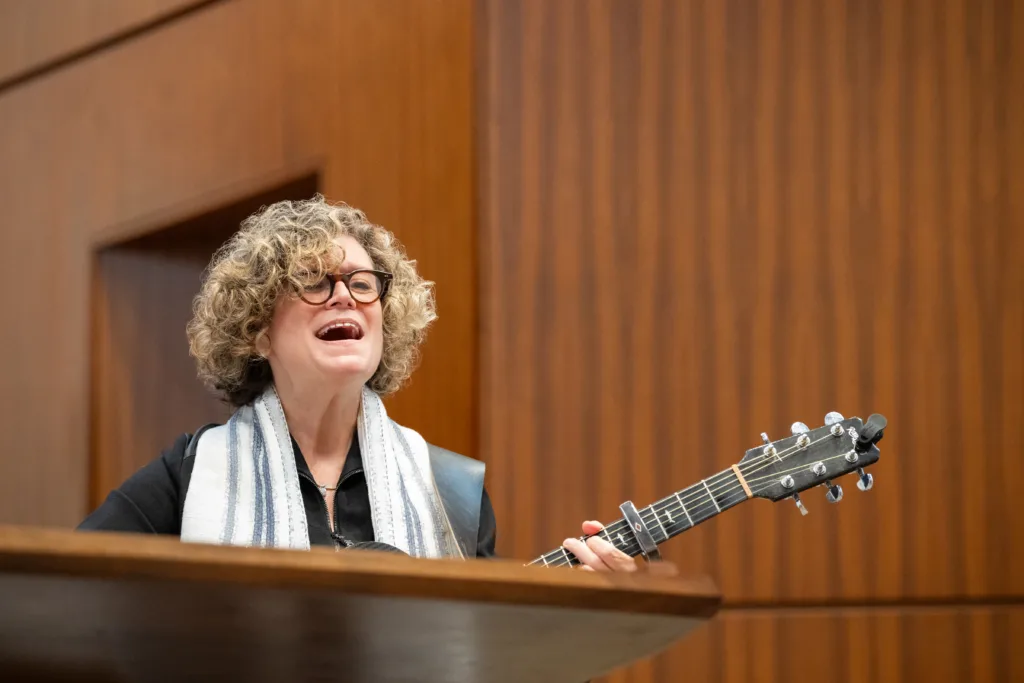
Beth Schafer
In Parashat Toldot, Rebecca does something few women in Torah ever do. Troubled by the struggle inside her, she goes “to inquire of God” (Genesis 25:22), and God answers her directly. Not through her husband. Not through a messenger. To her. She is told that two nations wrestle within her and that the elder will serve the younger. Rebecca carries that reply for decades, and she alone seems to understand what it asks of her.
Read quickly, Rebecca can look like a manipulator. She dresses Jacob in Esau’s clothes, covers his arms in goatskin, and sends him to deceive his blind father. But read again. Rebecca is acting on revelation. She knows which son can carry the covenant God made with Abraham, and she takes the risk upon herself to see that Jacob is put in place for the task: “Your curse be upon me, my son” (27:13). When Esau threatens Jacob’s life, she moves again, persuading Isaac to send Jacob to her family in Haran. Before he goes, Isaac blesses him with the blessing of Abraham, the promise of land and descendants (28:3-4). That moment does not happen without her.
Rebecca is future-thinking. She sees past the custom of bestowing the birthright to the firstborn and focuses on what the covenant actually needs to be realized. She is results-oriented, acting decisively when others might hesitate. Isaac, so often passive in his own story, is carried forward by her clarity. The trajectory of the Jewish people runs through her savvy.
Last week, voters across the country elected women to a remarkable number of firsts. Keisha Lance Bottoms, here in Georgia, became the first Black woman elected governor in American history. Deb Haaland of New Mexico became the first Native American woman elected governor, and Peggy Flanagan of Minnesota the first Native American woman elected to the U.S. Senate. Gina Hinojosa will be the first Latina governor of Texas. Ohio and South Carolina chose women for offices no woman had held there before.
What might they bring? Many women in leadership have learned to listen for what is not being said, to hold competing needs at once, and to think in generations rather than news cycles. Women who have stood outside the rooms of power often see what those rooms overlook: the caregiver, the child, the land, the community in the margins. Like Rebecca, they may be underestimated, even mischaracterized, when they act boldly. And like Rebecca, they may be the ones who make sure the promise reaches the next generation.
Rebecca heard God and acted. Our tradition endures because she did. May we recognize that same vision in the women who lead us now, and, God-willing, may all of us be blessed by it.
Shabbat shalom,
Beth