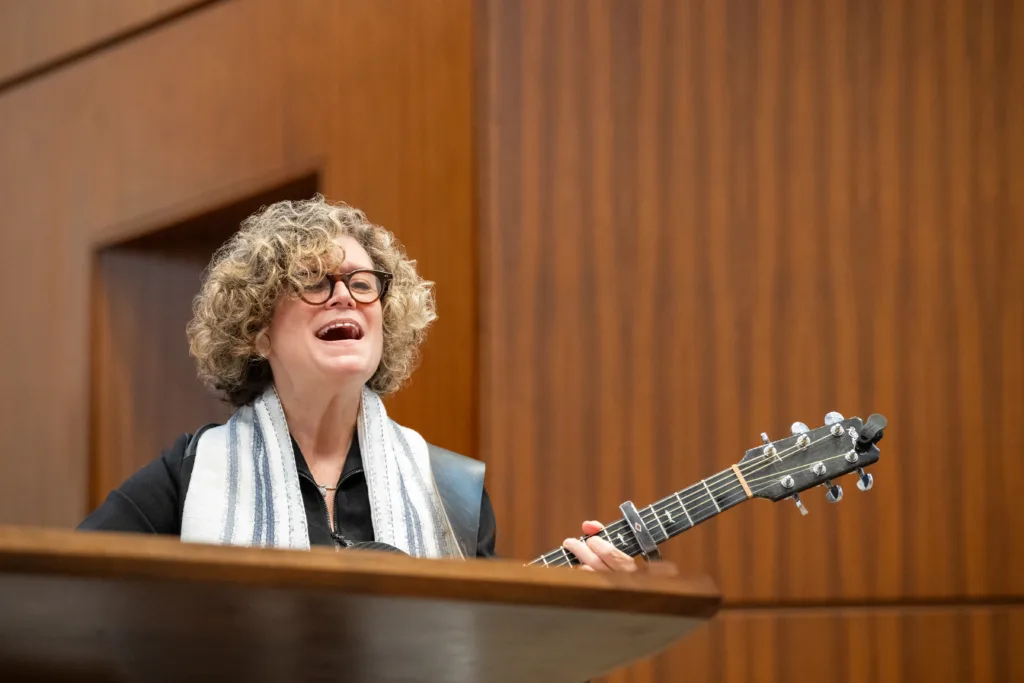
Beth Schafer
This week we begin Deuteronomy, the final book of the Torah. The Israelites have made it through the wilderness: enemies, internal power struggles, identity crises, questions about what life in the Promised Land might look like. As they stand at the entrance to the land promised to their ancestors, it’s clear Moses has concerns.
The generation with him at Mt. Nebo was born with the privilege of freedom, of manna, but the challenge of never knowing home. What teachings would anchor a people unmoored since birth? Deuteronomy is a book of urgency. Moses knows he isn’t entering the land with them. Can he instill in them the value of a freedom they never fought for, the preciousness of a land they’ve never seen? Can he help them envision a society that fulfills the dreams of Genesis? They are a generation removed from the miracle at the sea. Was the miracle of manna enough to cement their faith in God? The next forty chapters are Moses’s attempt to retell our story, imploring them to choose life, choose blessing, remember the commandments that make us unique.
Fast forward to today, here in America. The Jewish people, by and large, live a life of privilege. We are generations from the Holocaust, generations from the founding of the State of Israel. We have assimilated into American culture as we’ve assimilated into the cultures of every nation that has housed us. We are shaped by our history, but the urgency our children and grandchildren feel about their Jewishness is not the urgency we inherited.
Moses stood at Nebo carrying every fear a leader carries at the edge of a threshold: that freedom might be squandered, that the land could corrupt as easily as fulfill, that the power they’d waited forty years for might make them forget the vulnerability that shaped them. We stand at our own thresholds now, unsure whether comfort has dulled our urgency or crisis has narrowed our vision, wondering whether the story we tell ourselves is still strong enough to guide us once we’re actually holding the power we prayed for. Moses didn’t answer his anxiety with certainty. He answered it with instruction: with law, with memory, with the insistence that a people who once were strangers must never stop knowing what that felt like. Maybe that’s the course we chart too. Not by resolving every fear before we act, but by building the habits, memory, humility, care for whoever stands outside our door, that let us act rightly even while the fear is still present.
Shabbat Shalom,
Beth