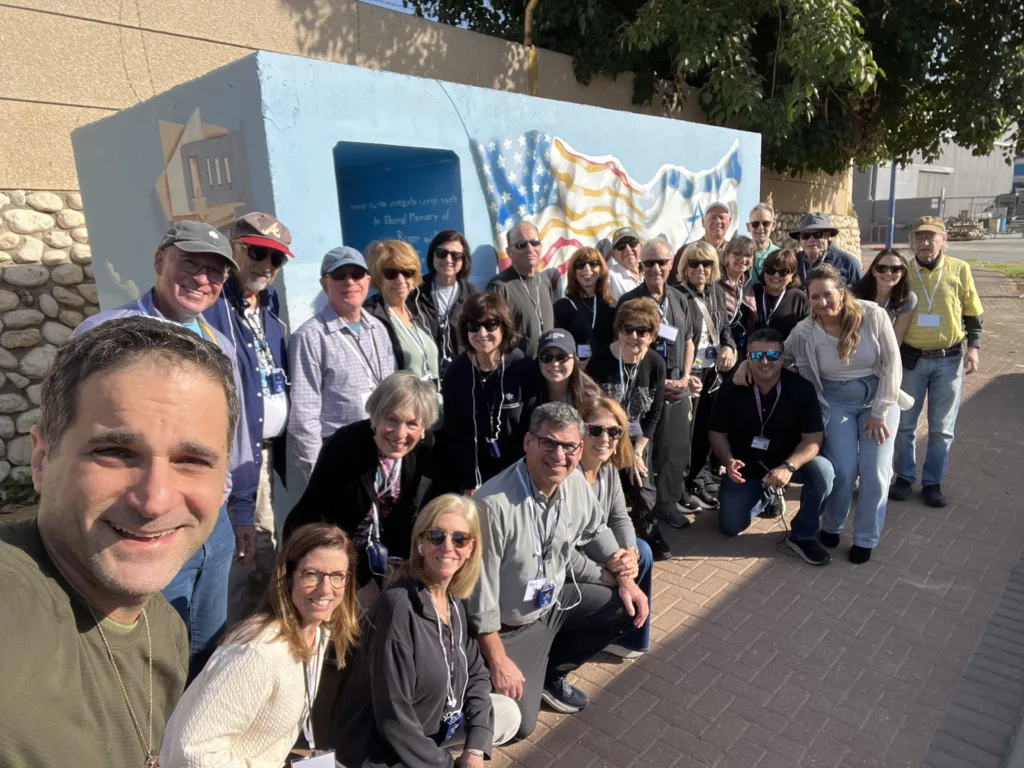
Reflections from Dale Bearman

Day 1, 12-2-25, Tel Aviv
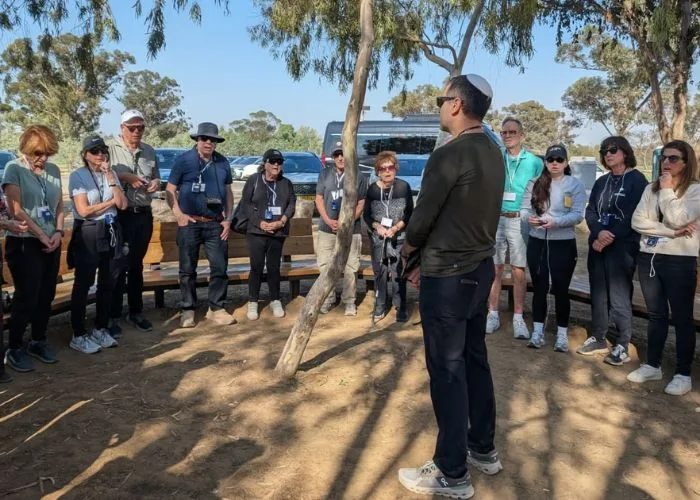
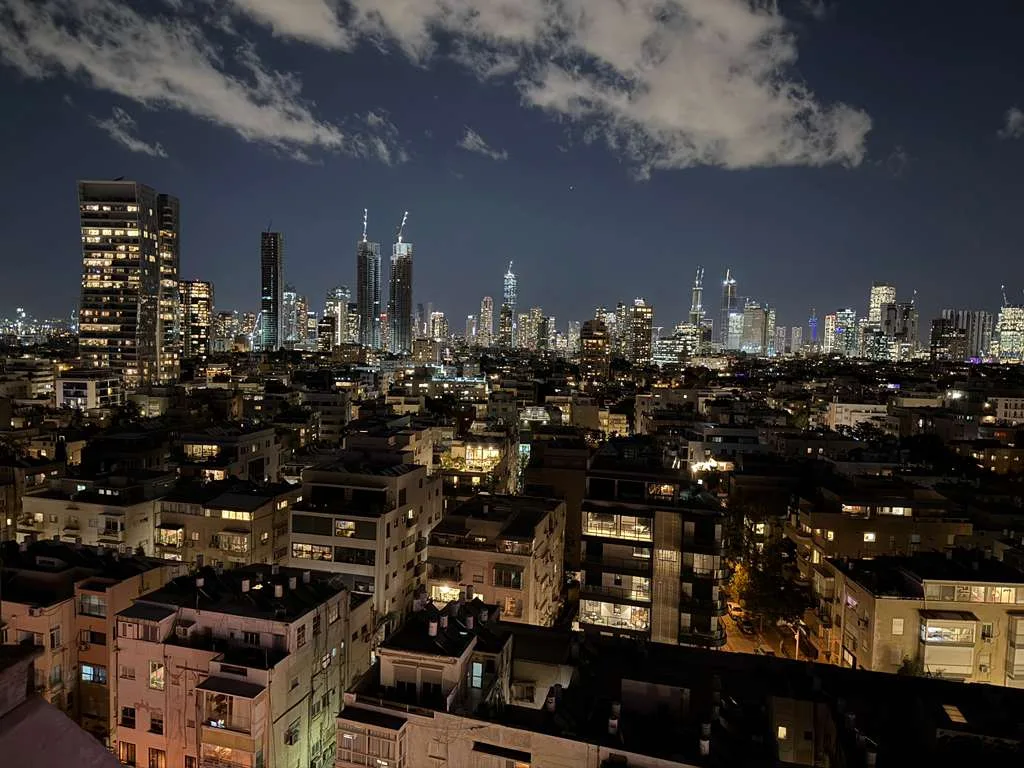
The trip officially started on the rooftop of the Carlton Hotel at 5:30 pm The group arrived using a multitude of travel pathways. Some had been here for several days, visiting with family and friends. Fantastic views of Tel Aviv skyline and the Mediterranean coast made the L’Chayim and Shehekianu a great start to the trip. Rabbi Natan Trief shared a poem from an Israeli poet that beautifully framed the purpose of the trip.
We are not here simply as tourists but as visitors seeking to understand and support the incredibly resilient people of Israel as they work to rebuild their lives following the tragic aftermath of the terrorist attacks of 10-7-23. After sharing a meal during which we got to know each other a bit, hearing from our guide Yoav Rotem, and enjoying the incredibly clear views of this beautiful city, we turned in early to get some rest after our travels. Everyone is excited to have this very special opportunity to learn, share, support Israel, and gain an understanding of how our lives, security, and future are inseparable from Israel’s people and society.
Day 2, 12-3-2025, Tel Aviv
After a massive breakfast buffet at The Carlton, we met for a lecture from Eran Shamir-Borer. He is an attorney with a PhD in International Law. The largest portion of his professional career has been spent in the IDF as a legal attaché on the team of attorneys representing the State of Israel at the International Court in The Hague as well as representing Israel to multiple foreign governments’ diplomatic services. He gave us a fascinating discussion of the legal basis and challenges of the conflict in Gaza, along with legal activities which are ongoing at The Hague. The legal principles governing combatants and the frustration stemming from the non-state status of the Palestinians were reviewed. Evidence of the use of civilian institutions (hospitals, U.N. Agency facilities, etc) as military participants was presented. Eran was a great speaker whose passion for Israel was clear. It stimulated a lively discussion and the group didn’t want it to end.
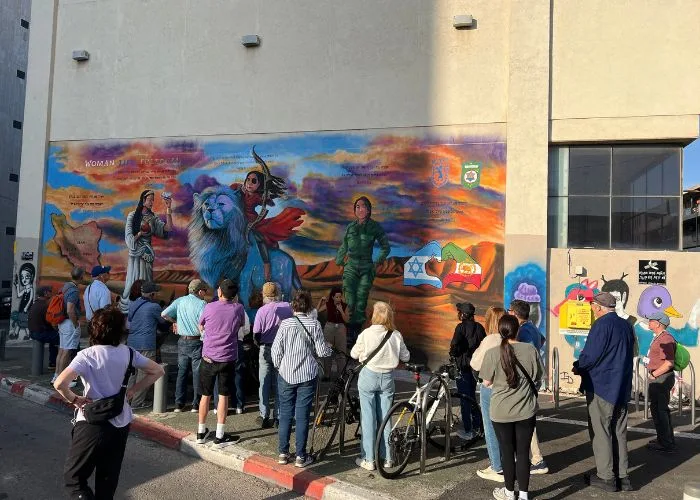
We then went to the Carmel market for a taste of the sights, sounds, and smells of the shuk. We regrouped after lunch for a trip to an industrial/warehouse/workshop area for an exploration of graffiti art. Our guide for this was Maya Yehezkel, whose impassioned explanations of the graffiti installations were fantastic. Since October 7th, there has been a commonality of themes for the pieces and Maya used the artist’s feelings to educate us on the events, the heroic actions of so many of the victims, and the societal frustrations of continued conflicts. She told their stories through the art and we all felt overwhelmed by the insights she provided.
Day 3, 12-4-2025, The Gaza Envelope
Left early today for the drive south to explore and understand more about the 10-7th attack on the communities surrounding the Gaza Strip. First stop was the city of Sderot, which has been a perpetual target for rocket attacks from Gaza for a couple of decades based on its proximity to Gaza. The number of shelters was overwhelming. These are separate from the shelters built into individual homes. We learned about how they help protect in case of a rocket attack, but did nothing for a terrorist attack where they actually trap victims inside.
We next visited the site of the Sderot police station battle, where Yoav beautifully explained the monument and its symbolism, which now sits on the site. After that, we climbed a small hill for a look at the Gaza security fence and a view of Gaza. Leaving Sderot, we stopped for a visit to a private memorial to the female military “listeners” whose warnings, unfortunately, went unheard on October 7.
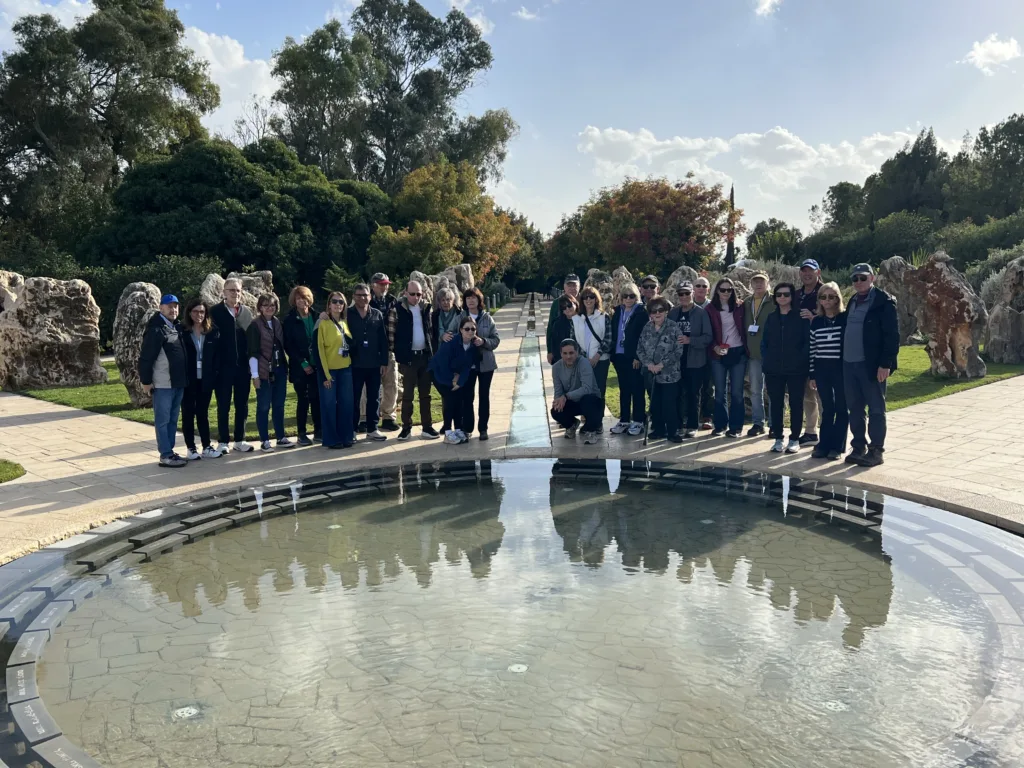
Our next stop was at the Re’im Forest, a JNF project, unfortunately, now engraved in our thoughts as the site of the Nova Music Festival, where so many lost their lives or were taken as hostages at the hands of Hamas terrorists in the early morning of October 7th, 2023. The site tastefully presents itself, honors the fallen and provides a quiet forest for reflection. Members of the group presented brief discussions about the lives of a few of the victims, and we held a short memorial service in their honor. Our driver, Benny, told us of his experience on 10-7 while trying to deliver Israeli troops to the area and he retold the horrific scene on highway 232, where the road was littered with destroyed vehicles and dead bodies of those ambushed trying to leave the Music Festival.
Following a brief stop, we visited the car cemetery where the thousands of burnt-out cars have been assembled as a lasting memorial. Seeing the vehicles used by those martyred and depicted in yesterday’s graffiti tour gave the stories a very tangible context. The day ended with a visit to Kibbutz Be’eri where Nieve Higgins gave us a tour of a destroyed neighborhood, where we witnessed the utter destruction of lives and property in the kibbutz which is in extremely close proximity to the Gaza fence and was one of the most heavily attacked of the Gaza Envelope’s kibbutzim.
We witnessed what a safe room looked like and, as is the case with the public rocket shelters, provided no protection from terrorist invasion. The solution to future security is not in building safer protections but in prevention of future attacks. Only through a transparent assessment of the failures leading to October 7th can this be accomplished. As shocking as the destruction appears, the hope for a thriving future in this community was clear from Nieve’s spirit and optimism. Temple Sinai and others have formed relationships with Be’eri and certainly other kibbutzim have done similarly. This is at least one way that we as American Jews can help with the rebuilding effort to bring these vibrant communities back, even better than before.
Day 5, 12-6-2025, The Golan Heights
The chilly morning started with an optional hike to a hot water spring on the edge of a reservoir at Merom Golan. Attended by about 1/2 of the group, we were surprised a bit by the near gale force winds, which added a bit of a challenge to an otherwise easy flat walk.
Following breakfast, we loaded up into 5 jeeps for a tour of the Syrian border. We learned about the active mine fields, fortunately fenced off and well marked. The effort to safely remove the many thousands of buried mines is a slow process, largely attributable to the high metallic content of the volcanic soil, which makes metal detectors useless. The removal process involves penetrating the soil with metal sticks by personnel wearing protective gear.
We came to an abandoned Syrian military command post where Ilan Shulman gave us a fascinating talk about the complexity of understanding the extremely heterogeneous groups within Syria, the evolution of the current regime, the puppet relationships with larger powers like Russia and Iran, and the uncertainty of future Israeli-Syrian relationships. Everyone was amazed at Ilan’s breadth of knowledge and felt that we were much more educated to give context to following the evolution of Israeli security as it pertains to Syria.
The jeep ride took us through tank paths, several memorials, and enabled us to look into Syria where ghost towns exist in the buffer zone. We entered the buffer zone through the Israeli military gate, went past modern Israeli tanks with incredible technology and speed.
Returning to Merom Golan, we boarded Benny’s bus for a trip Majdal Shams, one of 4 Druze villages in the Golan. We gained a better understanding of who the Druze are and their relationship to the land, their peaceful goals, and their belief in reincarnation. We also learned about their fabulous cuisine as we were treated to a sumptuous lunch in the home of an absolutely delightful woman named Fauzya, who fed us as if it were our last meal. We heard the family’s story and heard of their aspirations for a peaceful future.
We then visited the soccer field where 12 young members of this community lost their lives and dozens more were injured in a Hezbollah rocket attack from Lebanon in 2024. A son of this community currently living in Texas told us about the 12 Stars of Majdal Shams, the nonprofit currently trying to raise awareness, education, and promote peaceful coexistence. We saw the memorial under construction at the scene of the rocket attack.
Our day continued with a different sort of inspirational visit to Tel Winery, a boutique winery still in its formative years, but the real story here is the strong Zionist motivation and effort on behalf of Lital, who started this business from scratch. With the help of 3 other women, they complete all the tasks from planting, irrigation, harvesting, production, and sales of their wines. We tasted 6 of their single varietal wines they are making with locally sourced cheese, bread, olive oil, and apples. They were all fabulous and the spirit they demonstrated was really uplifting. It was clear that not only did they want to produce top-quality products, but the effort to create from scratch was reflective of the broader national effort to create a lasting and thriving Israeli society through hard work and perseverance. We share their hope for the future.
Following Havdalah led by Rabbi Natan Trief, we shared a terrific meal. After that, we met Eyal Dror, who was the founder and commander of the Good Neighbor project. This was an effort started during the Syrian Civil War, which partnered with Syrian health care providers and several communities to transport critically injured or severely ill civilians to Israel for specialized care not available in Syria. Slowly grown through fractured networking, it represented what being a good neighbor truly means. The program ended when forced migrations of entire communities during the conduct of the war made the program unworkable. Hopefully, some long-term memory of this good will be retained.
Day 6, 12-7-2025, The Lebanese Border
After breakfast, we loaded Benny’s Bus and departed Merom Golan for a morning of understanding the border with Lebanon. Eyal Dror spoke with us last evening about the Good Neighbor project with Syria was our guide for visiting 3 sites in the northern “finger” of Israel.
Our first stop was at Eyal’s home kibbutz, Dafna. We were met with fresh-picked blood red oranges from their grove. We heard from Orit, who is a long-term resident of Dafna, who told us of her life there just a few kilometers from the border. She introduced us to her son Arbil, a current leader of the kibbutz, and Leah, a woman from Toronto who made Aliyah and chose to raise her 4 children at Dafna.
The kibbutz is within the 5-kilometer evacuation zone mandated by the government after Hezbollah joined the attack on Israel shortly after October 7th. We heard about the support for civilians in the evacuation zone and how the 5 km measurement was chosen as that reflect the range of anti-tank missiles. All residents who chose to return did so by 8/2025. Residents living further away are basically on their own in terms of financial support.
Arbil then led us on a walking tour of the kibbutz with special notation of the Dan River, which runs right through the kibbutz. The memorial reflecting pool was a fitting tribute to the fallen. We came to the community garden, which is organized by Arbil’s brother and Orit’s son, Yotan. The garden is planted by placing a layer of compost on top of cardboard and growing the plants directly in the compost. It clearly works. Residents are free to come and pick whatever they need for their kitchens.
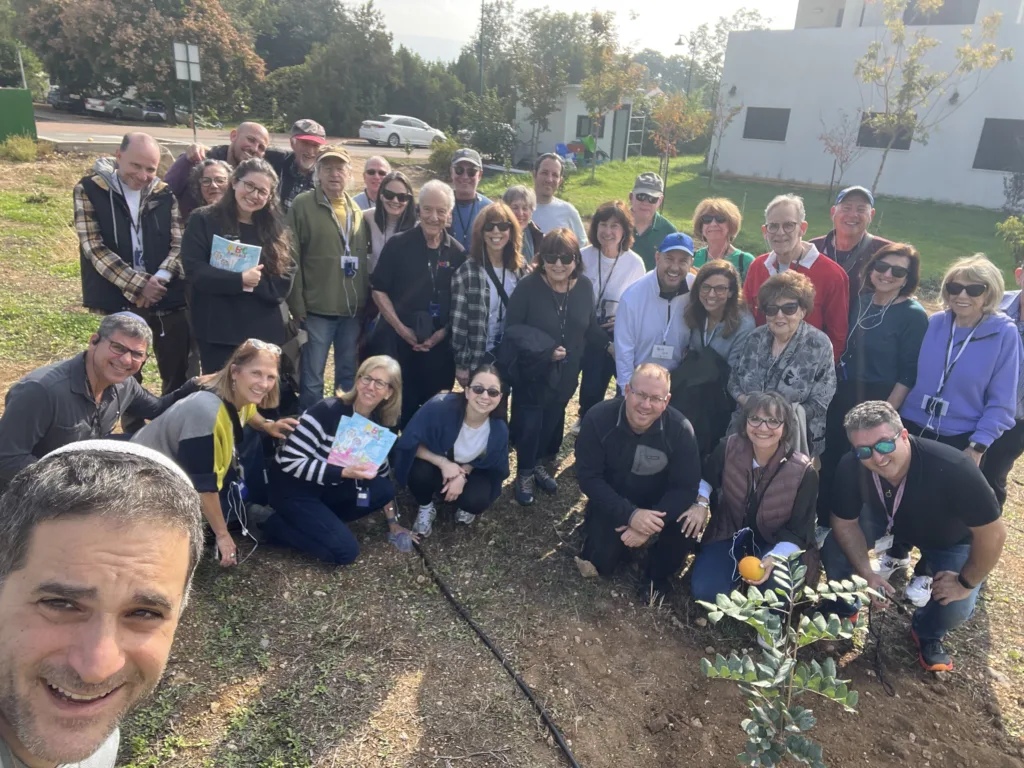
We were then privileged to participate in the planting of a carob tree. We hope to get a chance to return on a later trip to see it grow and bear fruit. Leaving Kibbutz Dafna, we visited the town of Metula, which is not only directly on the border, but surrounded by Lebanon on 3 of its 4 sides. Here we met a journalist named Rubi, a Metula resident who explained the unique situation of living in this beautiful town situated in this very exposed way.
We toured sites attacked by Hezbollah rockets, including a memorial to several community members who died in an orchard during an attack. We learned of the security zone in southern Lebanon and saw the ruins of previous communities used by Hezbollah terrorists. We also saw the Israeli outposts in the buffer zone.
Our next stop was at Kibbutz Misgav Am, which sits on a high bluff but is also right on the Lebanese border. It was an opportunity for Eyal and Yoav to explain more about the importance of this area for Israel’s defense. Following a lunch break where several of us enjoyed possibly the best falafel we’ve ever had, we said goodbye to Eyal who was incredibly generous with his time and clearly imparted a tremendous amount of information to us.
Just before leaving northern Israel, we make a brief stop at the helicopter memorial. This is a wonderfully simple and poignant memorial to the crews of 2 Israeli helicopters who tragically collided in 1997 in Southern Lebanon, losing all on board. We then headed toward Jerusalem taking the western route past the Kineret, overlooking the Jordan Valley, and through the edge of the West Bank.
Day 7, 12-8-2025, Jerusalem
Our day started early with a 7:30 AM departure from the Inbal. After picking up Yoav near his home, we headed to the Palmachim Base of the Israeli Air Force. After getting through security and special cell phone camera blockage, we divided into several groups to prepare and serve lunch to almost 2,000 young members of the IDF. This base is home to Blackhawk helicopters and other types as well. The personnel we served are helicopter pilots, mechanical support personnel, or general service personnel.
The grilling crew made countless hamburgers, chicken, and kebabs, and the serving crew made falafel, brisket sandwiches, schnitzel plates, and served the grilled meats. The gathering was an early Hanukkah celebration. Various units competed for the best hanukiah presentation. All the service men and women were extremely thankful for our being there and enabling this huge celebration to take place.
Rabbi Natan addressed the group and expressed our thanks for their service to Israel and for giving us the opportunity to be a part of their celebration. It filled us all with pride and gratitude to see these brave and incredibly young soldiers. Afterwards, the deputy commander of the base spoke with us and was extremely grateful for our group. The visit was really fun and very rewarding.
After a short ride, we went for a visit to Ma’ale HaHamisha, the kibbutz where Yoav currently lives. It sits atop one of the Judean Hills, and from one viewpoint just past a spectacular dairy farm, one can see all the way to the Mediterranean Sea to the west, Ramallah to the north, and Hebron to the south. From another location, you can see the sunset over Jerusalem. It was a perfect spot to discuss Israeli security as it pertains to keeping Highway 1 open and safe. This is essential for Jerusalem. It is in close proximity to three Israeli Arab towns and was a great demonstration that peaceful coexistence is feasible and has been mutually beneficial in this area.
Yoav and his wife Shani treated us to a L’Chayim in their home, which was accompanied by some deliciously sweet dates. This was so appreciated.
We then drove to the Old City and made a quick stop at the Western Wall. The connection to the Wall is so special. Rabbi Natan had brought several hundred prayers from Temple Sinai congregants, and the group ensured that they were placed in the Wall for them. The setting sun created spectacular color in the sky. It was a special moment.
Returning to the Inbal, we had a little rest before leaving for dinner in Gush Etzion, a cluster of Israeli settlements in the West Bank south of Jerusalem and Bethlehem. This was a home hospitality dinner. Yossi and Anat live in a house they built with their own hands on top of a hill overlooking Bethlehem. They served us a magnificent meal (I lost count after 15 courses) representing a variety of cuisines from the area, all accompanied by two red wines they made in their own vineyard.
Following dinner, Yossi sat with us and shared his feelings about the current situation in Israel. He discussed his recent military service experience in which he transported his own son to his post in Gaza. He gave us a very candid sense of what life is like in his area of uncertain future. It was incredibly interesting to hear his honest opinions with nothing held back. They were great hosts!
Day 8, 12-9-2025, Jerusalem, the Grand Finale
Today started with an early optional visit to the Temple Mount. Yoav gave us a clear perspective not only of the current state of the space, but also a historical understanding of Jewish life in the days of a central Temple, the role of the priests, the end of sacrificial observance, and the origins of communal worship.
Back to the Inbal to pick up the rest of the group for our visit to the recently opened National Library of Israel. Across the street from the Knesset and just up the street from the Israel Museum, this facility is a fabulous example of architectural beauty, function, and innovation. The Library contains two copies of every book published in Israel. The reading room displays about 250,000 of the 4.5 million books, but there are over 8 million items in total. All items are stored in boxes with no organization at all except the database, which tells the robotic device which box every item is in, in real time. After the box is delivered to the librarian, it is shared with the requesting individual. It is returned to any box available, and the database is updated. From request to delivery is 30 minutes—an unbelievable operation to witness.
Our docent, Naftili, showed us a remarkable video of the power of the written word, followed by a display of images of the thousands of Israelis killed on October 7th. This is an effort not only to memorialize the fallen but also to create a lasting repository of their words, texts, images, etc., so that future generations will have an opportunity to learn about their lives. We finished with the permanent collection of ancient and historic books of scripture, prayer books, haggadahs, and many other documents. To say that we were blown away by this Library is to minimize its impact on us.
From there we went to Mahane Yehuda Market, a mandatory component of any visit to Jerusalem. There we had the opportunity to sample so many wonderful foods, as well as do some shopping to help support the Israeli economy.
Our day continued with a visit with Israel’s premier expert on security, Col. Dany Tirza, the designer of Israel’s security fence. He gave us an impassioned history of Israeli border security and provided a basis for the need for ground security. We looked from a viewpoint in southern Jerusalem at the fence that separates the Bethlehem area from Jerusalem, and he explained how it was designed and why. We then drove to an area where a wall was built, and he discussed the procedures that allow workers from the West Bank to travel into Israel. The role of explosive-sniffing dogs was discussed, and the need to make that happen without offending the Muslim view of the uncleanliness of dogs by having the subject and the dogs in separate rooms. While the concrete walls (making up 12% of the security fence) are imposing, they have a hole near the top of each panel to enable their removal when they are no longer needed. May that day be soon.
Our next experience was a meeting with Einat Wilf, a former Knesset member and co-author of The War of Return. Einat is a direct and powerful speaker who held nothing back in explaining the Arab-Israeli conflict and sharing her perspective on the future of the region. Reading her book is exactly like listening to her. Her answers to questions from our group were extremely well-crafted and quite clear. Her ability to communicate is extraordinary, and she is not afraid to swim upstream in the realm of misinformation that is so prevalent in our media today. It was truly a privilege to hear her presentation.
Our last event of the trip was a dinner at Reshta restaurant, a Muslim-owned and operated restaurant in Ein Rafa, an Israeli Arab village in the Judean Hills just across Highway 1 from Abu Ghosh. This was a fantastic farm-to-table meal served by a delightful family. What a thrill it was to sing Happy Birthday (in English, Hebrew, and sort of Arabic) to Mike Levine, who turned 91 today. He is such an inspiration to us all.
That said, it was sadly time to say goodbye to this wonderful group as half went to the airport and half back to Jerusalem. Eight days ago, we were a diverse group ranging from age 32 to 91 and representing four different communities. We have been bound together by the privilege of learning and experiencing so much of the modern State of Israel. Despite this not being a trip designed for first-timers to Israel, so much of the content reflected new experiences. We can’t thank Rabbi Natan and Yoav Rotem enough for challenging us with this packed itinerary. It has been a great pleasure and true privilege to travel, learn, laugh, sing, and pray with such wonderful people.
Israel has left its mark on all of us. We will continue to be her advocates in our communities and hope to return as soon and as often as we can.