Click the links below to jump to a particular item on this page:
8a Yahrzeit Memorial Stand
8b Stained Glass Round Windows
8c Rabbinic Portraits
8a – Yahrzeit Memorial Stand
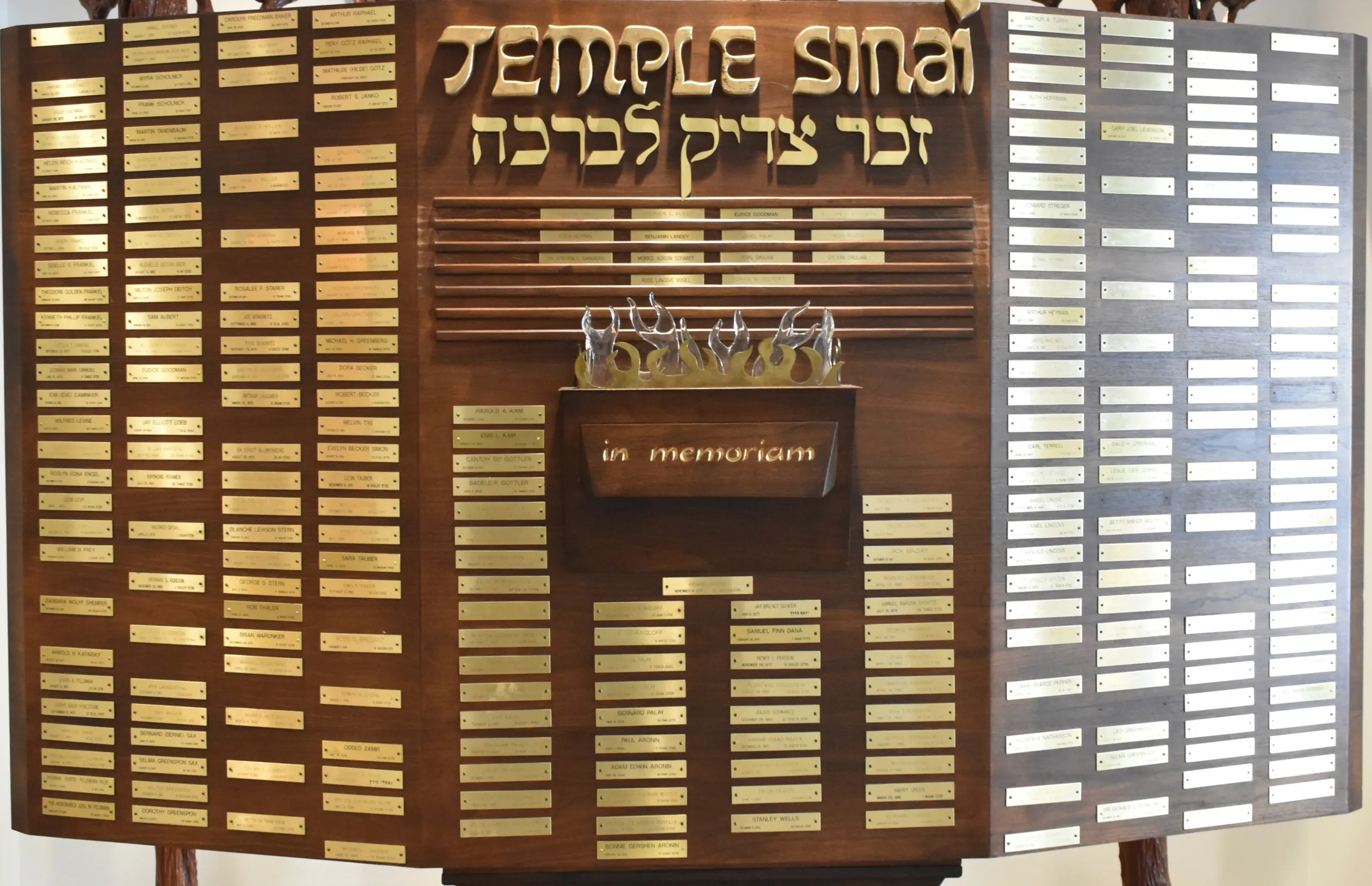
Inspired by Milton Deitch, z”l, a founding member and Past President
Designed and built by wood artist Timothy Sutherland
Acquired for the synagogue’s opening in 1973
At the time Temple Sinai’s building was completed in 1973, wall plaques were antithetical to the congregation’s egalitarian principles. Still, the desire for a tangible way in which members could memorialize loved ones ultimately inspired the creation of this Yahrzeit Memorial Stand, meaningfully designed to reflect tree of life. One of Sinai’s earliest pieces of art, the Yahrzeit Memorial Stand has been in continual use since the synagogue’s opening. Members who wish can purchase a brass marker with the name of their loved one to affix to the stand, and each week the plaques bearing the names of those whose yahrzeits are being observed are moved to the front of the “tree” and placed beneath the Hebrew words: “Zecher tzadik livracha – the memory of the righteous is a blessing.”
Reflection from Maurice Rosenbaum:
Memory plays such an essential role in Judaism that it is even considered a mitzvah to remember ancestors and loved ones who preceded us. I recall from childhood that on one of the walls of the synagogue my family attended were countless names of people’s relatives and loved ones. I remember looking for family and friends’ family names that I knew and thinking the previous generations in which they lived. This Yahrzeit Memorial Stand, bearing the names of former members and ancestors of Sinai congregants, is also a repository of sacred memory for all who come on Shabbat evening to honor the yahrzeit of a loved one. And while the names may not be as familiar, they nonetheless evoke thoughts about generations past, and also help me to make a personal connection with a fellow member who is there to remember.
8b – Stained Glass Round Windows
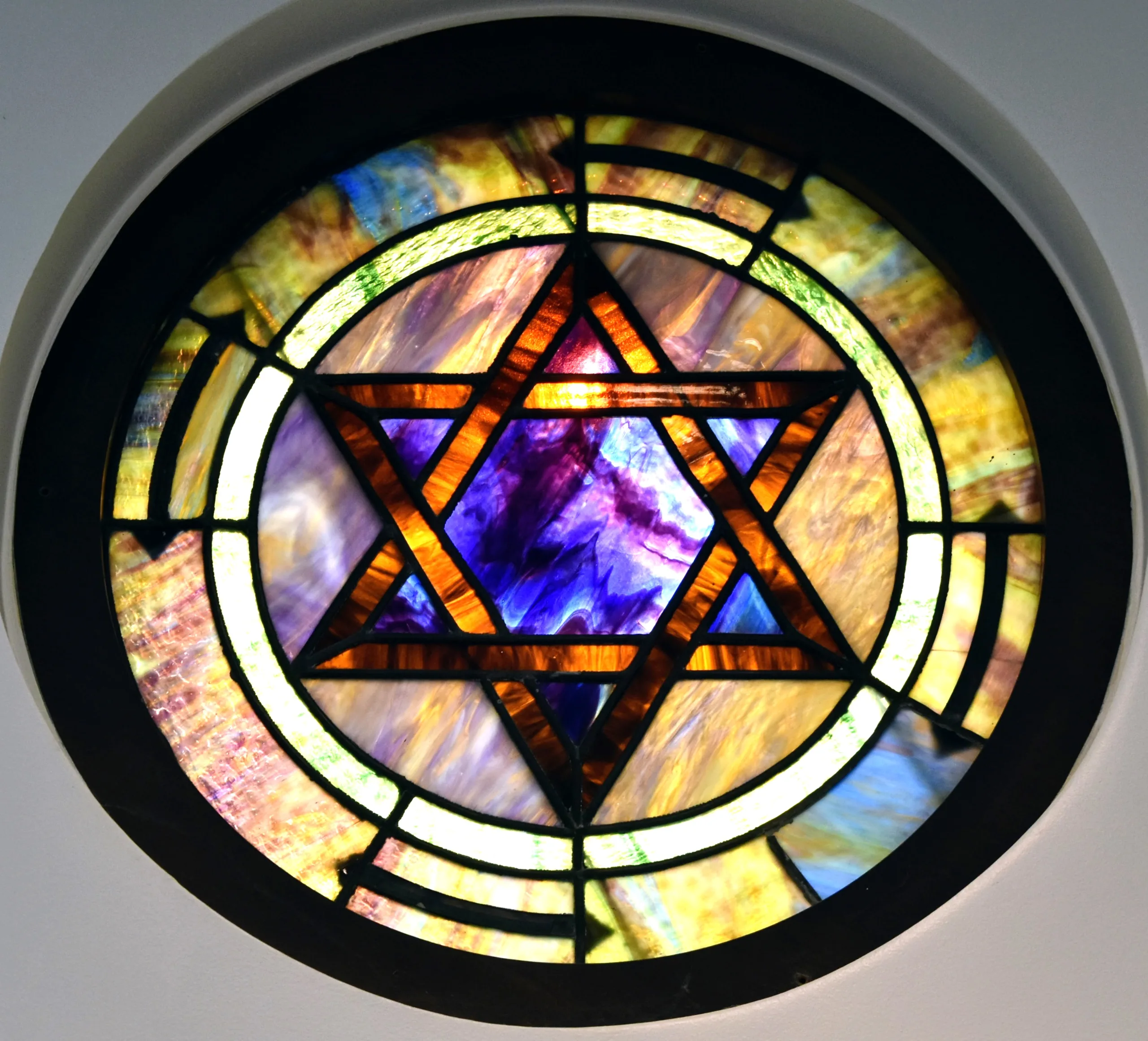
Installed 2004
Gift of Rita and Herschel Bloom and Linda and Gregory Bloom
These antique, round stained glass windows formerly graced the sanctuary of Congregation Beth Israel in Clarksdale, Mississippi, at one time the largest Jewish congregation in Mississippi. Clarksdale’s first Jewish settlers arrived in 1894, and the congregation as well as the synagogue they established enjoyed a long and meaningful history. Sadly, as the Jewish community dwindled, a fate similar to countless small cities throughout the South, so, too, did the temple’s viability. Beth Israel held its final Shabbat service in May 2003, after which all items of Judaic significance were removed from the building (which now serves as a church). These beautiful and historic windows were brought to us by congregants whose family members were affiliated with Beth Israel, and Temple Sinai is proud to display them as an enduring tribute to the countless individuals who planted Jewish roots in the deep South.
Reflection from Greg Bloom:
These stained-glass windows were first set in Congregation Beth Israel, once the heart of Jewish life in Clarksdale, Mississippi. Jewish families arrived in the Mississippi Delta in the late 1800s, drawn by opportunity and community. In 1896, a small group of families founded a congregation—worshiping first in homes and rented halls before dedicating their first synagogue in 1910. These windows were two of the eight from the second larger synagogue, built in 1929.
For generations, Beth Israel anchored a vibrant Jewish community that helped shape Clarksdale’s civic, commercial, and cultural life. At its height, it was among the largest Jewish congregations in Mississippi. As economic shifts led families elsewhere, the congregation held its final service in 2003.
These windows were donated by Herschel and Rita Bloom and Greg and Mindy Bloom. Herschel and Greg grew up in Clarksdale and later became members of Temple Sinai, carrying the light and legacy of their hometown forward for future generations.
8c – Rabbinic Portraits
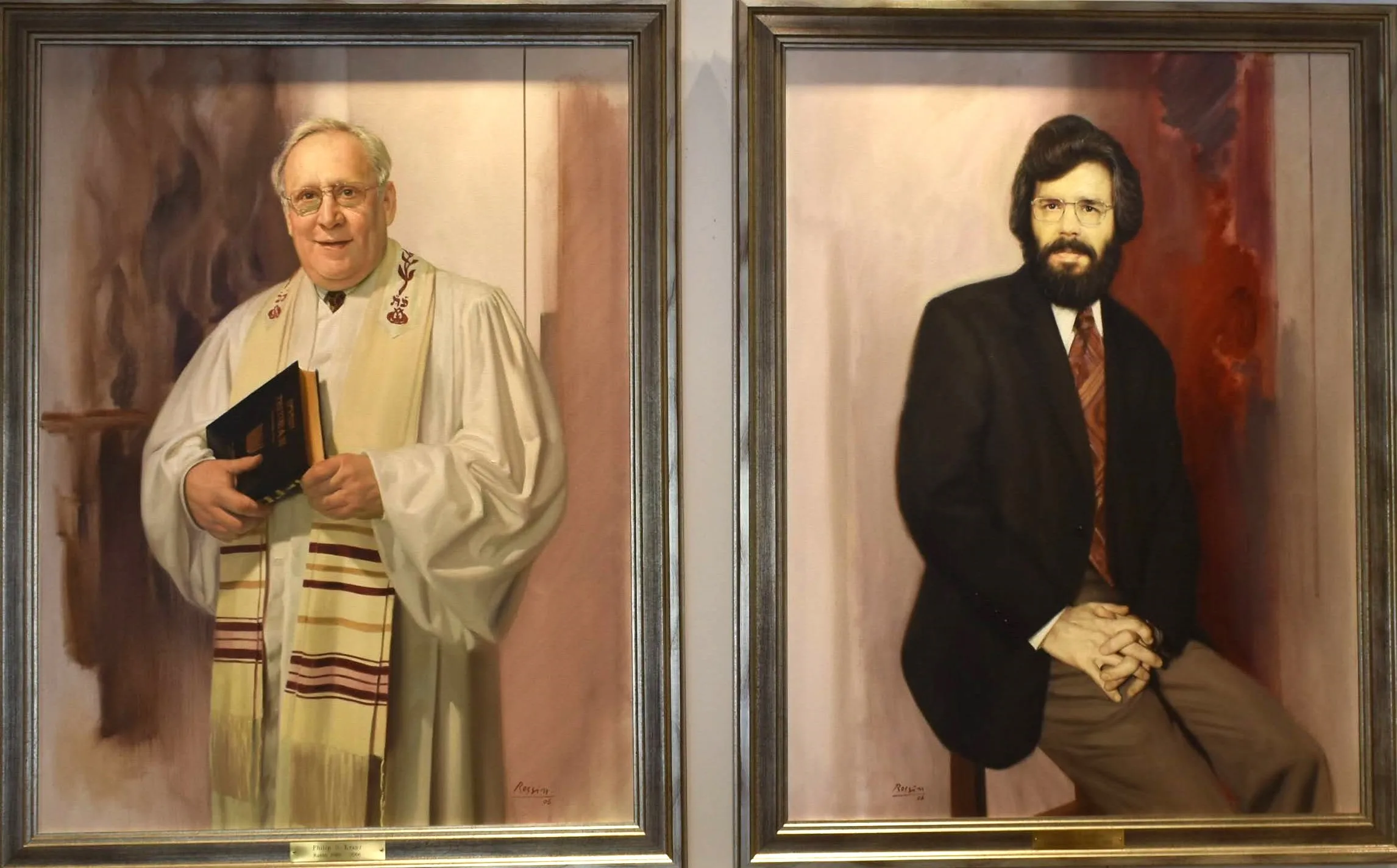
Rabbi Emeritus, Philip N. Kranz, z”l (1980-2006)
Founding Rabbi, Richard J. Lehrman, z”l (1968-1979)
Artist, Ross R. Rossin
Gift of Roger and Corky Gelder
The portraits before you are of Temple Sinai’s two esteemed Rabbis Emeriti, both of blessed memory. The portrait of Rabbi Phil Kranz, z”l, was unveiled at his retirement celebration in 2006 following 26 years of devoted leadership and service to Temple Sinai. Rabbi Kranz remained active in the life of the congregation, teaching, writing, and helping to build and oversee the collection in the Kranz Library and Learning Center until his death in April 2026. The portrait of Sinai’s founding rabbi, Rabbi Richard Lehrman, z”l, who served Temple Sinai from 1968 until his untimely death in 1979, was actually painted at the same time as Rabbi Kranz’s portrait, although the only photo the artist had to work from was a headshot of Rabbi Lehrman. A fun tidbit of Sinai trivia is that, from the neck down, the remainder of Rabbi Lehrman’s portrait is painted from a photograph of Rabbi Ron Segal.
Reflection from Rabbi Sam Trief:
At the time of this recording, our congregational family is approaching the end of shloshim, nearly thirty days since the passing of Rabbi Phil Kranz, the second rabbi to lead Temple Sinai. His portrait, alongside Sinai’s founding rabbi, Rabbi Richard Lehrman, who died in 1979, now seems to carry an even greater element of sanctity and importance.
Looking at these portraits, I keep returning to words I shared during shiva for Rabbi Kranz:
“There are few people who shape a community the way Phil did. I feel that I owe so much to him, and I feel a profound responsibility to help carry forward the congregation he built and entrusted to all of us. He was there for generations of families, guiding them through every sacred and significant moment of their lives. But who will be there for their children, and for their children’s children? That responsibility now rests with us. And we are called to meet it with the same integrity, empathy, and compassion that he modeled every single day.”
To stand on the shoulders of Rabbi Kranz, and Rabbi Lehrman, whose presence is also deeply woven into the story of this congregation, is both a tremendous honor and an immense responsibility, one I do not take lightly. What these rabbis built here is far too precious to simply admire from afar. Their inspirational rabbinates are an enduring charge for every rabbi who has the privilege of serving Temple Sinai – to demonstrate the same level of dedication and to emulate their examples: in every sermon we deliver, every class we teach, every hospital room and home we visit, every lifecycle we officiate, and every relationship we nurture within this sacred community. And in doing so, may we continue to honor and celebrate the enduring gifts they gave to all of us.