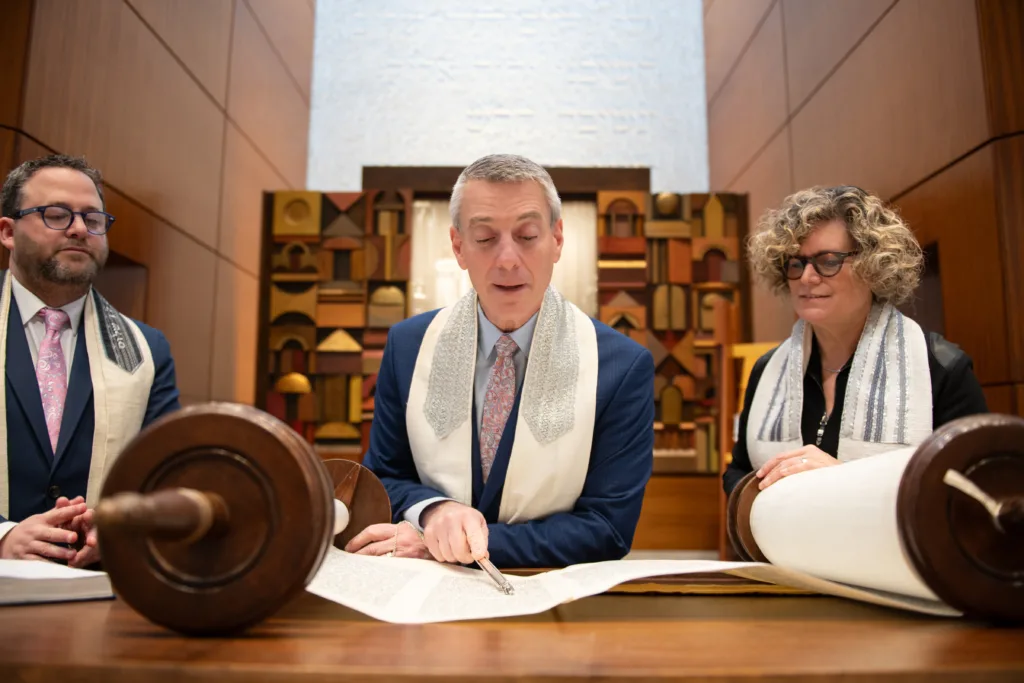
Rabbi Ron Segal
One of the commandments of Purim is to turn everything on its head and to celebrate in such a manner that one doesn’t know the difference between “cursed be Haman” and “blessed be Mordecai.” While many adults might choose to fulfill this mitzvah with particular beverages, more people – adults and youth – focus on the masks we wear, whether literally as part of a Purim costume, or figuratively with the masks we wear throughout our lives. The wearing of costumes enables us to turn things on their head by disguising our identities or taking on a new persona during our holiday observance. Equally significant, though, is our ability to turn things on their head, not by putting on but by removing the figurative masks …. we feel compelled to wear; we were led to believe we had to wear; we have worn due to feelings of insecurity; or…
Purim celebrates the heroism of Mordecai and Esther, who managed to thwart Haman’s malevolent aims to destroy the Jewish people. Esther, as we likely recall, had kept her Jewish identity hidden, masked, from the King. However, at the critical moment when it became clear that the safety and survival of the Jewish people demanded bold action, Esther – at Mordecai’s urging – chose to “remove the mask regarding her identity.” Even with the potential risks, Esther knew she could no longer remain silent, and she stepped out of the shadows. Esther used her agency to help avert the decree against her people, and in so doing, succeeded in turning everything that had been planned on its head. When Mordecai calls upon Esther to step up and save the Jews of Shushan from destruction, he says to her: “Who knows, maybe it was for such a time as this that you are in your position.”
In his book For Such a Time as This (title inspired by this verse), Rabbi Elliot Cosgrove writes, “Esther does not choose her moment; it chooses her. She is being asked to [remove her mask] and rise to the occasion. The exchange between Mordecai and Esther is a turning point, not just in the biblical story but in all our stories. There is a happenstance nature to our lives – far more is beyond our control than within it. What we can shape, however, is our response to whatever is happening. Mordecai’s words to Esther are a reminder of the role of human agency in an out-of-control world often filled with pain” (p. xvii).
So, in the spirit of Purim this year, consider – Is it time to turn things on their head?! Perhaps this is the critical moment when we are called upon to courageously step forward, remove the mask we’ve been hiding behind, and use the agency we each possess to make a positive difference – to advocate for truth, to display compassion, to model understanding, and to work for much-needed peace. Chag Purim Sameach!